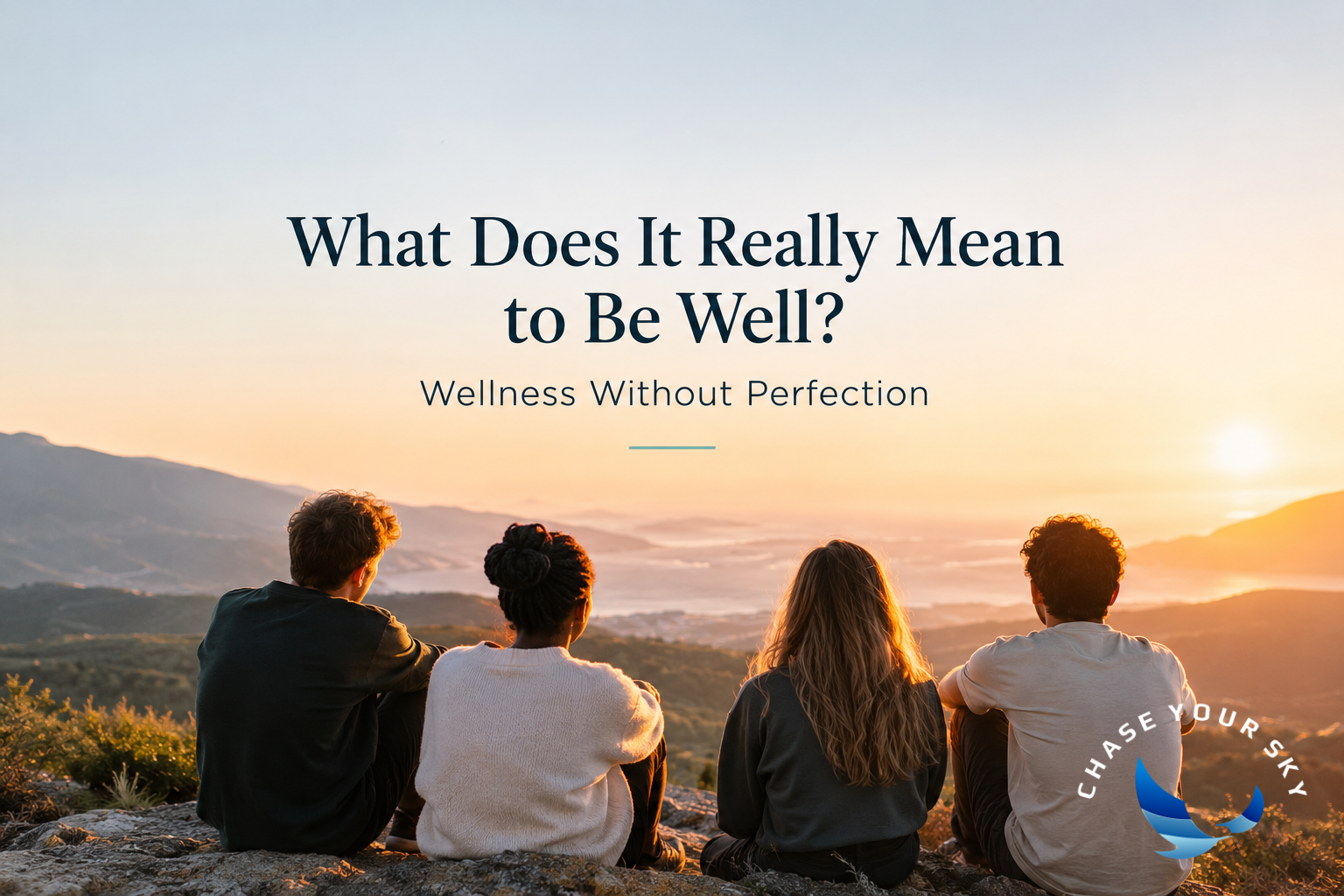

Wellness without perfection means recognising that being well is not about having the perfect body, routine, career, diet, or mindset. It is about understanding yourself, caring for your whole wellbeing, and giving yourself room to grow.
We live in a world where we are constantly encouraged to become better. A better version of ourselves. A better routine. A better career. A better life.
There is nothing wrong with growth. But when wellness becomes another standard we feel pressured to achieve, we can lose sight of what wellbeing is really about.
At Chase Your Sky, we believe wellness is personal. It can involve physical health, mental wellbeing, self awareness, meaningful relationships, personal growth, and the choices we make every day. Most importantly, wellness does not require us to have everything figured out.
Ethan
Wellness Begins With Understanding Yourself
Most of us have a working definition of wellness that starts and stops with the body. Enough sleep, regular movement, decent food, maybe a wearable tracking all three.
Those things matter. But they’re the floor, not the whole house.
I’ve coached enough talented, disciplined, outwardly successful people to know that someone can check every box on that list and still feel quietly, persistently off. Like they’re managing their life well without actually living it.
That gap is where real wellness lives.
Not in the absence of stress or the presence of a perfect routine, but in the relationship you have with yourself. How well you know what you actually want, what drains you, what you’re carrying that was never yours to carry, and whether the life you’ve built still fits the person you’ve become.
Here’s the pattern I see most often.
Someone spends years getting good at meeting expectations. A boss’s, a family’s, an industry’s, or their own inherited idea of what a successful life is supposed to look like.
They get very good at it.
And somewhere inside that competence, the question of what they actually want gets quietly shelved.
Wellness starts to erode long before anyone notices because, from the outside, everything still looks fine.
This is why self awareness isn’t a soft add on to wellbeing. It’s the foundation of it.
You can’t align your life with what matters to you if you’ve never taken the time to find out what that is. You can’t change a pattern you haven’t noticed. And you can’t move toward something with intention if you’re not honest about where you’re actually starting from.
That is where Life Coaching earns its place.
A good coaching relationship isn’t advice giving or problem solving on someone’s behalf. It’s a structured, honest space to do the kind of thinking most people never carve out time for on their own.
In my own practice, I lean on a framework I call the Sky Chase Cycle: Ground, Lift, Align, Ascend.
Ground is where we get specific and honest about the present. Not the version of your life you present to other people, but what’s actually true right now.
Lift is where we start noticing the patterns and inherited beliefs that have been quietly running the show. Old rules about worth, productivity, and permission that made sense once and may not anymore.
Align is where we reconnect daily choices to what actually matters, so your calendar and your values stop living in two different rooms.
Ascend is momentum. Not a finish line, but sustained movement in a direction that’s genuinely yours.
That cycle works because it isn’t a one time fix.
I also teach something I call Checkpoint Thinking. The idea that growth isn’t a straight line toward some perfect, finished version of yourself. It’s a series of honest check ins.
Where am I right now?
Does this still fit?
What needs adjusting?
People burn themselves out chasing an endpoint that was never really there. Checkpoints allow you to course correct without treating every stumble as failure.
So when someone asks me what it really means to be well, my honest answer is this:
Wellness isn’t a state you achieve and then hold onto. It’s an ongoing, active relationship with yourself, built on clarity about who you are, honesty about where you stand, and a willingness to keep adjusting as you grow.
Coaching doesn’t hand you that relationship. It gives you a structure and a partner for building one, checkpoint by checkpoint.
You don’t need to have it all figured out to be well.
You just need to be willing to actually look.
Blessing
Wellness in a World That Constantly Tells Us to Be Better
We live in a world where we are constantly being told to improve.
Scroll through social media and there is always something new to work on. A better body. A better routine. A better career. A better morning routine. A better version of ourselves.
There is nothing wrong with wanting to grow. Growth is an important part of life. But the constant pressure to become better can sometimes make us feel as though who we are right now is not enough.
Working in digital marketing has made me especially aware of how much our daily lives are influenced by what we see online. Social media can inspire us, educate us, and connect us with people who encourage us to take better care of ourselves.
But it can also create comparison.
We often see the finished version of someone else’s journey without seeing the uncertainty, setbacks, difficult days, or quiet moments behind it.
This can make wellness feel like another goal we have to achieve perfectly.
We may start believing that being well means having the perfect routine, always being productive, eating perfectly, exercising consistently, or always feeling positive.
But real life does not work that way.
Wellness can look different from one person to another. Sometimes it can mean taking a walk, getting enough rest, spending time with people we love, setting boundaries, or simply giving ourselves permission to slow down.
Sometimes wellness means recognising that we are struggling and allowing ourselves to ask for support.
I think this is where we need to change the way we talk about wellness online.
Instead of presenting wellness as a perfect lifestyle that everyone should achieve, we can create conversations that remind people that they are human.
We can encourage growth without making people feel inadequate. We can celebrate progress without creating comparison. We can talk about self improvement while still reminding people that their worth is not dependent on how much they accomplish.
Perhaps being well is not about constantly becoming someone better.
Perhaps it is also about becoming more aware of who we already are, understanding what we need, and learning how to care for ourselves along the way.
Wellness does not have to be another standard we fail to meet.
It can simply be a journey of becoming more connected to ourselves, one step at a time.
Lamberto
The Wellness Conversation Online: Between Inspiration and Expectation
There are so many different ideas online about what it means to live your “best” life.
For some, wellness means becoming stronger and healthier. For others, it means improving their appearance, building confidence, finding balance, or simply becoming a better version of themselves.
Social media has made these conversations more accessible than ever.
With millions of people sharing their routines, transformations, advice, and personal experiences, wellness has become a community driven conversation.
But alongside the support and awareness comes another side of the conversation: comparison, unrealistic expectations, and the pressure to present a perfect life.
When Wellness Becomes About Looking Perfect
Beauty and appearance have become a major part of online wellness culture.
One example is the rise of “looksmaxxing,” a movement centred around improving physical appearance through everything from grooming and fitness to more extreme approaches.
There is nothing inherently wrong with wanting to feel confident in how you look. Taking care of yourself can be a meaningful part of someone’s wellness journey.
The problem begins when appearance becomes the measure of someone’s worth.
Some online communities can push particularly negative ideas about appearance, relationships, and personal value. For someone consuming this type of content repeatedly, self improvement can stop feeling empowering and begin feeling like an endless requirement to become “good enough.”
That is where the wellness conversation needs to change.
The Positive Side of Wellness Communities
Social media is not simply a source of unrealistic expectations.
It has also created communities where people feel seen, understood, and supported.
TikTok, Instagram, YouTube, and other platforms have made it possible for people to find incredibly specific communities based on their interests and goals.
Fitness content can introduce someone to healthier habits. Pilates communities can encourage movement and confidence. Mental wellness creators can help normalise conversations that people may previously have felt uncomfortable having.
These communities can provide education, motivation, accountability, and a sense of belonging.
For someone beginning their wellness journey, seeing another person share their struggles can be just as valuable as seeing their success.
That distinction matters.
A wellness conversation should not only show people where they could go. It should also remind them that where they are right now has value.
Moving Beyond the Perfect Life
One of the biggest challenges with wellness content is that social media naturally encourages people to present the highlights.
We see the finished transformation, not every difficult day that came before it.
We see the healthy meal, not the days when someone struggled to stay consistent.
We see the confident person, not necessarily the uncertainty that existed behind the scenes.
When these moments are constantly placed next to our own everyday lives, comparison becomes almost inevitable.
The result can be a version of wellness that feels less like self care and more like a checklist.
The perfect body.
The perfect routine.
The perfect diet.
The perfect career.
The perfect relationships.
The perfect mindset.
But a meaningful life does not require perfection.
Sometimes wellness means going to the gym. Sometimes it means taking a walk. Sometimes it means journaling, resting, spending time with people you love, or simply allowing yourself to enjoy a moment without worrying about whether you are improving yourself.
There are experiences in life that cannot be measured by a before and after photo.
Creating More Authentic Wellness Conversations
If social media is going to continue shaping the way we think about wellness, the conversation should become more authentic.
That means creating space for both progress and imperfection.
Creators can share the process instead of only the outcome. Brands can focus on education and meaningful support instead of making people feel inadequate. Communities can celebrate different definitions of wellness rather than promoting one universal standard.
Most importantly, people should be reminded that wellness is personal.
What helps one person may not work for another.
One person’s goal may be building physical strength, while someone else’s goal may be gaining confidence, managing stress, developing healthier habits, or simply finding more joy in everyday life.
There is no single appearance, routine, or lifestyle that makes someone well.
Fiona
What I’m Learning About Wellness and Growth
When I was a kid, I thought wellness was an adult thing. I honestly found it a little funny, something people did when they had their life together.
Now, after going through different experiences and becoming a young adult, I see it very differently.
I’ve started to notice how many assumptions people have around wellness and taking care of yourself.
Sometimes it is treated as unnecessary, indulgent, or even a little ridiculous.
But I actually think that if more people had ways to pause, breathe, and take care of themselves, there might be a lot fewer problems.
For me, wellness can be as simple as meditation, going to a spa, getting a massage, spending time doing something spiritual, being in nature, journaling, or even just putting my phone away and sitting in silence for a while.
I don’t see these things as escaping reality.
I see them as taking a moment away from the noise of everyday life so I can come back to reality with a little more energy.
I learned that lesson in a very real way when I was 19.
Four months into university, I was studying full time while also working full time. I barely had any free time, and somehow I still felt like I should be doing more.
On paper, everything was going well.
Then, almost out of nowhere, I started having panic attacks.
Eventually, I had to force myself to stop.
I took two weeks away from university and work and gave myself permission to do almost nothing. I went to therapy, started meditating again, spent time with friends, and talked openly with the people around me about what I was afraid of.
It was uncomfortable, but it taught me something I hadn’t understood before.
Sometimes doing more isn’t the answer.
I’m still someone who likes to be busy. I want to work, learn, have hobbies, spend time with my cats, experience things, and keep moving forward.
But I’ve learned that there is a difference between being busy because you are genuinely enjoying your life and growing, and being busy because you are afraid of wasting it.
I don’t want to stop being ambitious. I just want my ambition to come from the right place.
I’ve also become much more conscious of how I take care of my body.
For me, wellness is increasingly about understanding that your mind and your body are connected.
I still overthink. I still have moments where old fears come back in waves. But I have learned ways to calm myself down.
Sometimes I try to bring myself back to logic. Sometimes I sing a song to myself. Sometimes I let myself cry and release everything instead of fighting it.
These little things don’t magically make every fear disappear, but they usually help me return to the moment.
I’m also learning that wellness doesn’t have to be complicated or take hours out of my day.
Sometimes a few quiet minutes are enough to remind me that I’m here, I’m living, and I don’t have to constantly be doing something to make my life meaningful.
I think becoming yourself is also about accepting that your life might not look exactly how you once imagined it.
I’ve learned that you can’t always go back and recreate an old chapter. Sometimes you have to appreciate what it gave you and allow yourself to create a new memory instead.
That’s probably what growth means to me right now: reaching my career and personal goals, having a healthy balance between work and life, being happy, and making sure that when I look back a year from now, I’m not exactly the same person I was.
I’m still figuring it out.
I don’t think that means I’m behind.
If anything, one of the biggest things I’m learning is that I’m not alone in figuring things out. Someone else is probably experiencing something similar, even if you can’t see it.
Maybe we don’t need to have everything solved before we start taking care of ourselves.
Bringing It All Together
Wellness Without Perfection
Wellness does not require perfection.
It can be a few quiet minutes, a conversation, a walk, a journal entry, a coaching session, a healthier choice, or simply giving yourself permission to stop.
It is about understanding yourself, caring for yourself, growing intentionally, and becoming more aligned with the life you actually want to live.
Our different perspectives may look different, but they lead to the same place.
Wellness is not about proving that we have achieved the perfect life.
It is about learning to understand ourselves, recognising what we need, finding support when we need it, and continuing to grow.
You are allowed to be a work in progress.
You are allowed to change direction.
And you are allowed to take care of yourself while you are still figuring it out.
Wellness does not require perfection. It is a journey of understanding yourself, caring for yourself, growing intentionally, and becoming more aligned with the life you want to live.
That is wellness without perfection.
